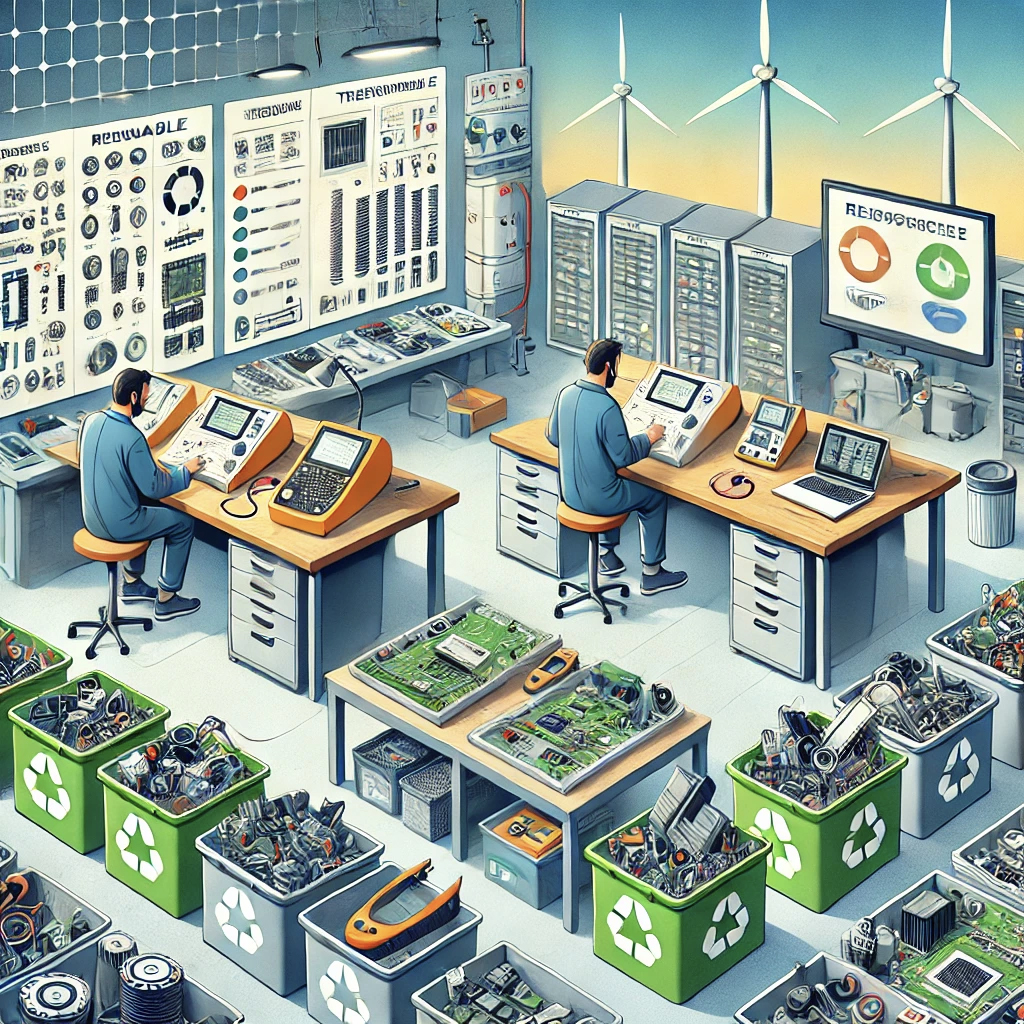
Sorting & Testing Collected Components
Introduction
After collecting discarded electrical components, the next step is sorting and testing them to determine their suitability for reuse, refurbishment, or recycling. This ensures maximum efficiency, minimizes waste, and optimizes the sustainability of renewable energy applications.
Sorting Process
To streamline processing, components were categorized into three groups:
1- Reusable Components – Fully functional parts that require minimal adjustments.
2- Repairable Components – Items with minor faults that can be refurbished.
3- Recyclable Components – Non-functional parts that can be processed for material recovery (copper, aluminum, lithium extraction).
Each category underwent rigorous testing to ensure quality and efficiency before reintegration.
Testing Methods & Outcomes
🔋 Battery Testing
✅ Conducted charge retention and voltage stability tests.
✅ Used battery analyzers to assess remaining capacity.
✅ 70% repurposed for second-life energy storage; others recycled for material recovery.
🔌 Circuit Board Diagnostics
✅ Tested electrical conductivity, signal integrity, and resistance.
✅ Used oscilloscopes and digital multimeters to assess viability.
✅ Functional components were reused in renewable energy projects; damaged ones were recycled for copper and silicon recovery.
⚡ Transformer & Power Converter Testing
✅ Assessed voltage stability, efficiency, and heat dissipation.
✅ Used power analyzers and infrared thermography for performance evaluation.
✅ Efficient transformers were refurbished for microgrid applications, while degraded units were recycled for copper wire recovery.
Key Results
📊 70% of components were successfully reused or repaired.
♻ 15% were recyclable, with materials extracted for reuse.
🛑 15% required eco-friendly disposal due to irreparable damage.
By implementing these rigorous testing procedures, the project maximized sustainability and reduced electronic waste.
Impact
🌍 Reduced landfill waste by repurposing functional components.
⚡ Enhanced energy efficiency by reusing high-quality materials.
💰 Lowered costs by reducing the need for new raw materials.
 Zahra Blogs
Leave a comment